Ahn Jung-geun's Last Prison Calligraphy Goes on View in Seoul
An eight-character inscription Ahn Jung-geun brushed in a Chinese prison cell in March 1910 is on view at the National Palace Museum of Korea through Dec. 27, free admission, checked Oct. 27, 2026.
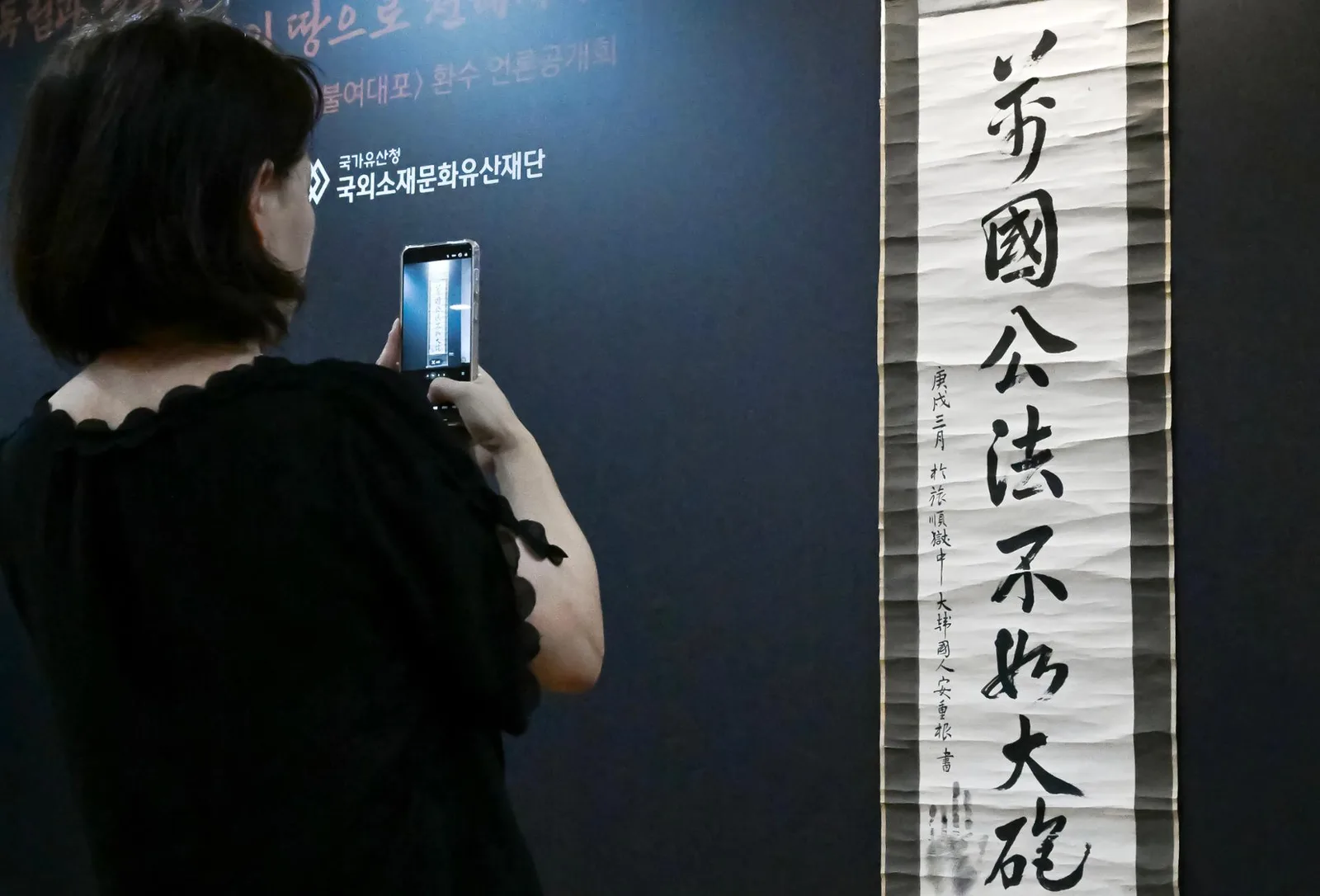
The National Palace Museum of Korea has opened a special exhibition built around a single object: eight Chinese characters that independence activist Ahn Jung-geun brushed onto paper inside Lushun Prison in Manchuria in March 1910, days before his execution. Titled "A Solitary Encounter: Eight Characters Left by Ahn Jung-geun," the show runs at the museum's gallery in central Seoul through Dec. 27, the Korea Times reported, timed to the 117th anniversary of Ahn's 1909 assassination of Hirobumi Ito, Japan's first prime minister and resident-general over colonial-era Korea.
The calligraphy reads "International law falls short of cannon fire," a line Ahn wrote to condemn how treaties and diplomatic law failed to stop imperial powers from seizing weaker nations. He wrote it in the final weeks before his death on March 26, 1910. Japanese guards reportedly collected his brushwork as keepsakes, so much of his output ended up outside Korea for over a century.
This particular sheet stayed abroad for 116 years before the Korea Heritage Service and the Overseas Korean Cultural Heritage Foundation confirmed its existence in May 2025 and arranged its return that November. The National Palace Museum sits inside the Gyeongbokgung Palace grounds at 12 Hyoja-ro, Jongno-gu, in Seoul. Admission is free, and the museum opens daily except Mondays from 9 a.m. to 6 p.m., with no separate ticket required for the Ahn exhibition, according to the museum's standard visitor policy, checked Oct. 27, 2026.
Ahn produced more than 200 calligraphic works during his imprisonment, by the National Heritage Portal's count. Roughly 60 survive today in Korea and abroad. Thirty-one hold South Korean National Treasure status, a designation that began in 1972, when 26 of his pieces were recognized at once. The Seoul exhibit extends a recovery effort that has continued for more than five decades.
Some pieces remain abroad. A separate Ahn work titled "Independence," held by Ryukoku University in Kyoto, is the subject of a stalled negotiation led by Gyeonggi Province, which has set aside 1.3 billion won in private capital to buy it back. Talks are set to continue through the end of 2026. If they collapse, the province says it will return the funds as unused.
City and shopping editor
Covers the practical order of a Korea trip and what to bring home: airport buses and their stops, transit cards, luggage storage, and the K-beauty products worth carrying back, named by their official product names with what the label says.