Seochon's stylish lanes are also its most contested real estate
Seochon's hanok lanes west of Gyeongbokgung still hold a terrace bistro, a niche perfumer and a jewelry workshop, but rising foot traffic and rents are reshaping the neighborhood block by block.

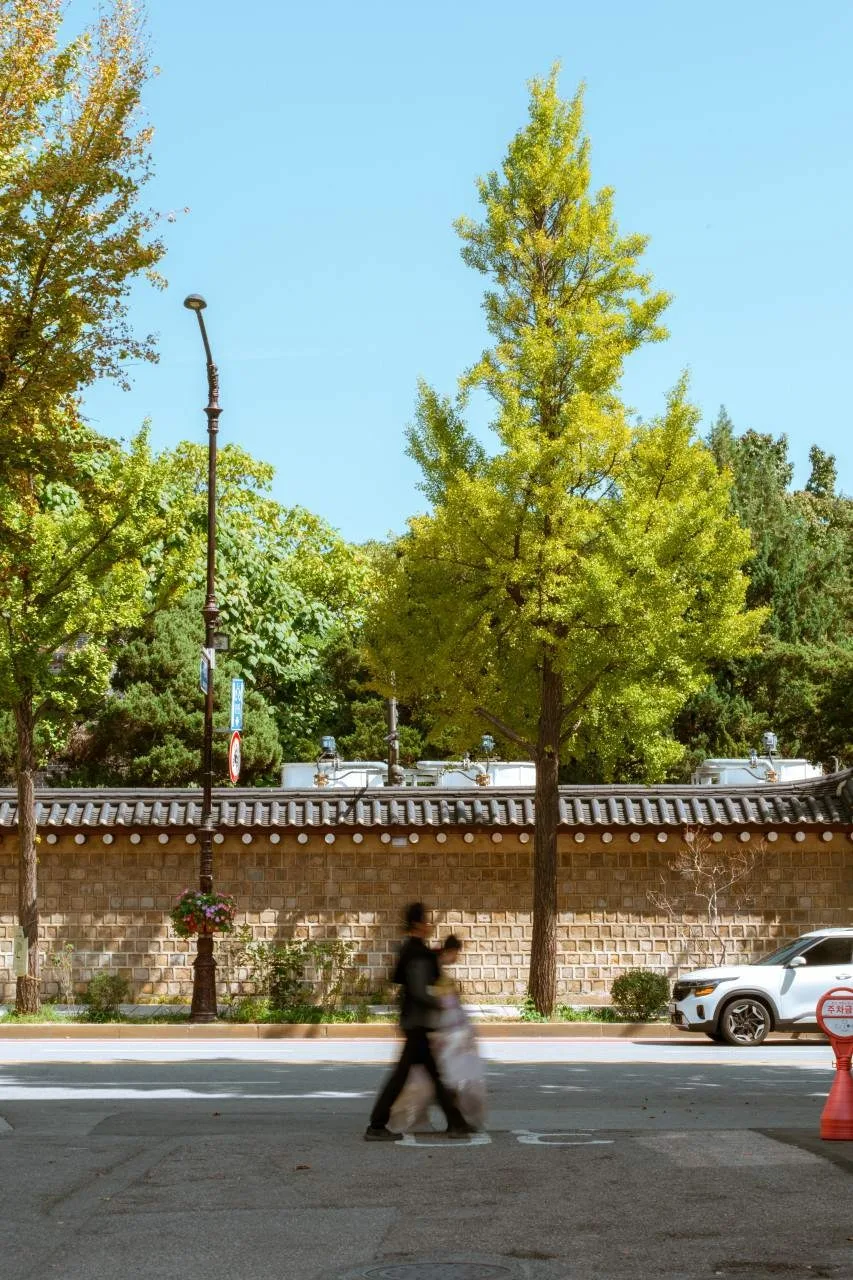
Exit 2 of Gyeongbokgung Station, on Seoul's Line 3, drops walkers onto a plain street corner, then almost immediately into something older. Within a block, the apartment towers give way to low hanok rooftops stacked beneath the granite face of Inwangsan, and the grid of the modern city loosens into a tangle of alleys that make up Seochon, the "western village" that sits just outside Gyeongbokgung Palace's side gate.
The stylish stretch of that walk runs through Tongin-dong and Hyoja-dong, where a terrace bistro spills onto a stone wall, a vintage photo booth sits wedged between a flower shop and a hanok gate, and a niche perfumer shares a lane with a small jewelry workshop that still cuts and sets by hand. Further along, international fashion flagships have taken over what used to be single-story homes, their glass fronts reflecting the palace's stone wall across the street. One cafe built into a renovated hanok faces that wall directly, its window seats positioned so customers look out at the exact line where Joseon-era masonry meets contemporary Seoul.
The neighborhood has carried that mix of old and new for centuries. King Sejong, the fifteenth-century ruler credited with commissioning Hangul, is said to have been born in Seochon, and the Joseon painter Jeong Seon lived at the foot of Inwangsan, close enough to the mountain to paint it directly and to trade visits with intellectuals of his era. That lineage is one reason Seochon has drawn writers and artists in waves ever since, long before any bistro or perfumer moved in.
Compared with Bukchon, the hanok district north of the palace that now draws dense tour-group traffic, Seochon has been described by the South China Morning Post as the quieter alternative, its narrow lanes holding small galleries and concept shops rather than souvenir stalls. That reputation for calm is precisely what has started to erode it.
According to the Korean business outlet Bizhankook, Seochon's Cheongun-hyoja-dong area logged average daily foot traffic of roughly 37,890 people in the first quarter of 2026, a rise of 242 from the previous quarter and 342 from a year earlier, with the number of stores climbing to 946. A local real estate agent quoted in that report said inquiries about available buildings had risen two to three times over the past year or two, with almost no commercial vacancy left to fill. Bizhankook ties that surge to Gangnam-based investors moving capital into the neighborhood as its foreign and younger domestic foot traffic climbs.
The Korea JoongAng Daily documented what that pressure looks like for the people who have run shops there for years, reporting on a restaurant owner whose landlord raised rent to 12 million won, about $10,700, nearly four times what he had been paying. Korea JoongAng Daily The same paper has separately tracked the physical toll on the neighborhood's hanok housing stock near the former Blue House, citing a 2015 survey that counted 616 hanok remaining in Seochon, down 50 to 60 from a count taken five years earlier as owners tore down traditional houses to put up buildings that could command higher rents. Korea JoongAng Daily
Asia Economy has framed the pattern as a distinctly Korean style of gentrification, one less about residents being priced out of their homes and more about the wholesale conversion of a lived neighborhood into a commercial one, where old functions disappear and spaces get repurposed faster than anyone can track. Asia Economy Seoul's city government has pushed in the opposite direction with public programming such as Seoul Hanok Week, reported by the Korea Times in July 2026, which pairs free weddings and cultural events with efforts to keep historic houses occupied as something other than tourist backdrops. Korea Times
None of that shows up on the walk itself. What a visitor sees from Exit 2 is still the low rooflines against Inwangsan, the perfumer's narrow storefront, the jewelry workshop's hand tools laid out on a felt mat, the cafe window framed by the palace wall. The tension sits a layer beneath the surface, in the space between one shopkeeper's old lease and whatever rent a landlord decides the next one is worth.
Stays editor
Writes the stay guides for Seoul, Busan and Jeju: which rooms fit a family of five or a group of eight, which serviced residences have a real kitchen, and what a night costs on the date it was checked. Prices and terms are taken from the property's own page and the booking platform on the same day.